
“Sabahattin, gather your friends and come here... come to Bodrum, I will take you to Gokova. See well, live and understand what beauty is.”
The year was 1945. That letter came from Cevat Şakir Kabagağlı, a fisherman from Halikarnassus, who lived as a kalebent in Bodrum.
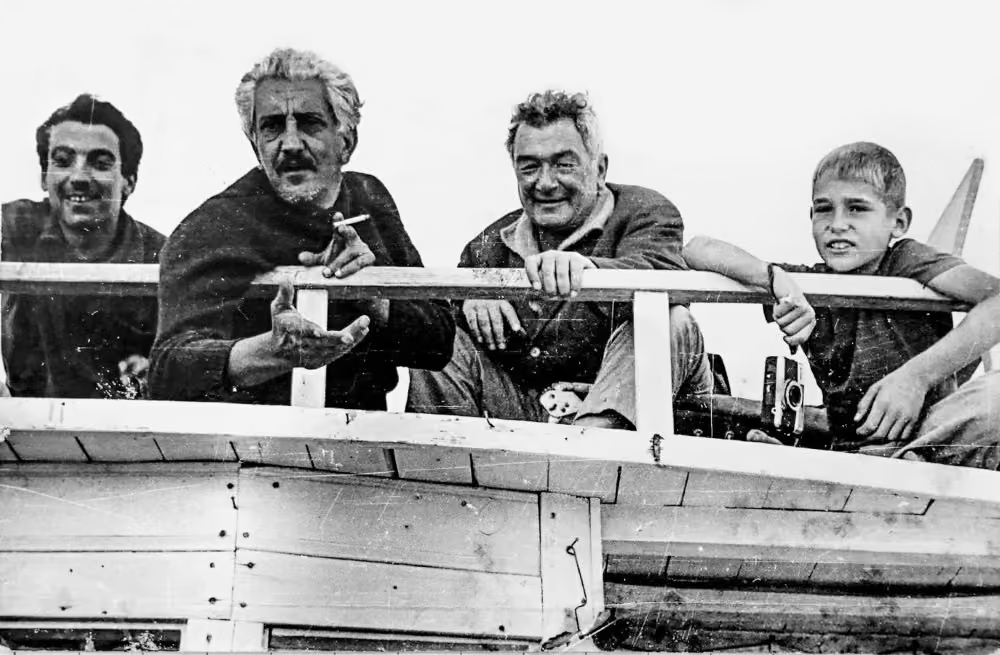
Sabahattin Eyüboglu, his brother Bedri Rahmi and their friend Erol Güney called this call more than an invitation, a call for enlightenment They saw it as. In those years, Bodrum was a place of exile. The path was a place where only the brave would fall. And those brave ones set off in a fishing boat: Blackbird. There was no kitchen on the boat, no toilet. But there was: an idea, a dream, a blueness...
The journey that arose from that letter was the first step in the culture we call the “Blue Journey” for today.
And perhaps it was the moment when Turkey was reacquainted with the sea.
Jevat Şakir's call was not only to his friends, but to the heart of a civilization.
He wanted to define Anatolia in the light of the Aegean, not the West.
Sabahattin Eyüboglu, Bedri Rahmi, Erol Güney, Fuat Ömer Keskinoğlu, Necati Cumalı...
They all met on the deck of Karakush to see and share that light in the footsteps of the Fisherman.
And there, Blue Anatolian thought was born.
“This sea is embroidered with blue green, this sea is toothed like a quince...”
said Bedri Rahmi.
That sea was the place where art, thought, man was reborn.
An idea, a philosophy, a way of life
The Blue Voyage was not a vacation.
It was a resistance: against concreting, forgetting, against the spirit stuck in the city.
The sea replaced books; sailing became a metaphor for thought.
Azra Erhat said, “As soon as the journey of a Gokova is over, a tortuous longing for the second begins in man,” in fact, he was describing the bond established with blue.
These journeys, which Eyüboglu called the “blue trip”, turned into a cultural heritage that will last from 1946 to 1973.
This adventure, which once began on the boat of the sponger Paluko, was voyages in which women spent days without looking in the mirror, men unshaven but free.
They were rehearsing sharing, solidarity, being human in the middle of the sea.
The Fisherman's dream was embodied in the hands of the Bodrum masters.
As the demand for blue travel increased, sponge boats were not enough;
the trichandlers turned into gulets.
Boats were born with a spine from pine, a soul from salt, a hull from a dream.
The seafarers of Bodrum put into shape the dream of blue travelers.
The elegant lines known today as the “Bodrum gulet” are the labor of those years.
The sound of wood to the sea is now the music of the Aegean.
The sailors of those years were, in Azra Erhat's words, men who “had no words of good in their lûgat.”
They sailed, found direction, passed through the bays like a tunnel of fear.
Sabahattin Reis's “Come on!” There was, he said, a seascape that reached into bottles, but waited first for the captain's meal.
And they didn't just travel, they discovered.
For the first time, blue travelers saw the frescoes of Knidos, Cedar Island, the sunken cities of Kekova.
In ancient theaters they sang the choirs of ancient Greek Dionysus.
The sea had become a history teacher.
The first blue voyages became the “Karakuş”, later became the boat “Hürriyet”.
Until 1986, it was the flagship of the blue voyage.
Then came “Nostalgia” and “Akin A”.
Captain Mehmet Demirel, Durmus Deveci, Aksona Mehmet...
All of them became names that carried that blue consciousness from generation to generation.
Today marks the 37th anniversary of The Bodrum Cup.
And this year's theme is: Generations.
This is not a coincidence; it is a blessing.
Because The Bodrum Cup is the last link in the chain that stretches from that first letter of the Halicarnassus Fisherman to the present day.
Every gulet sailing in that race today is an inheritor of the Blue Voyage.
Each captain carries a greeting of Sabahattin Eyüboglu with the wind.
This is what Shadan Gokova said to the fisherman one day:
“This place is not what you left.
Those who call Bodrum not 'Zepyria' but 'Bedroom' multiplied.”
The Blue Voyage, however, was navigation, not debauchery.
It was a culture, a consciousness, a blue dress.
Today, The Bodrum Cup reminds us again of that consciousness:
The sea is not just a place to visit, but to live.
As Azra Erhat said:
“One can spend a lifetime here, not a week, ten days.
Such a blue, such a green that...
If I paint a painter, it is enough to make a man human.”
The first blue passengers saw that blue.
We are living that legacy.
We've been chasing the same wind for generations.
Because some journeys don't end — they just change hands.
Editor: Selda Öztürk